A failed collection is an expensive way to discover that the freight sitting in the loading bay is not the freight the carrier was expecting.
With heavy machinery, relatively small differences can change the job. A pallet turns out to be wider than booked. A machine has been mounted on a skid after the quote was obtained. The weight came from an old specification sheet. The vehicle arrives and there is no equipment on site capable of loading it.
None of those problems begins on the road.
For industrial shippers, the most useful pre-dispatch check is therefore one that compares the finished consignment with the transport booking before the driver is sent.
Is the base suitable for transport?
Machinery does not always distribute its weight evenly.
Two machines with the same total weight can place very different demands on a pallet or skid if one spreads its load across a broad base and the other concentrates it through a handful of mounting points.
The support underneath the machine has to suit the load.
That might mean a suitable heavy-duty pallet. For larger, unstable or unusually shaped equipment, a purpose-built skid, stillage or cradle may make more sense.
The important point is that the load can be handled safely and gives the carrier a practical means of securing it to the vehicle.
Load security also does not belong entirely to one person. The consignor has a role in presenting suitable freight, while the operator and driver retain their own responsibilities for the vehicle and the load once it is transported.
Good preparation makes those responsibilities easier to fulfil.
Compare the booking with what is actually on the floor
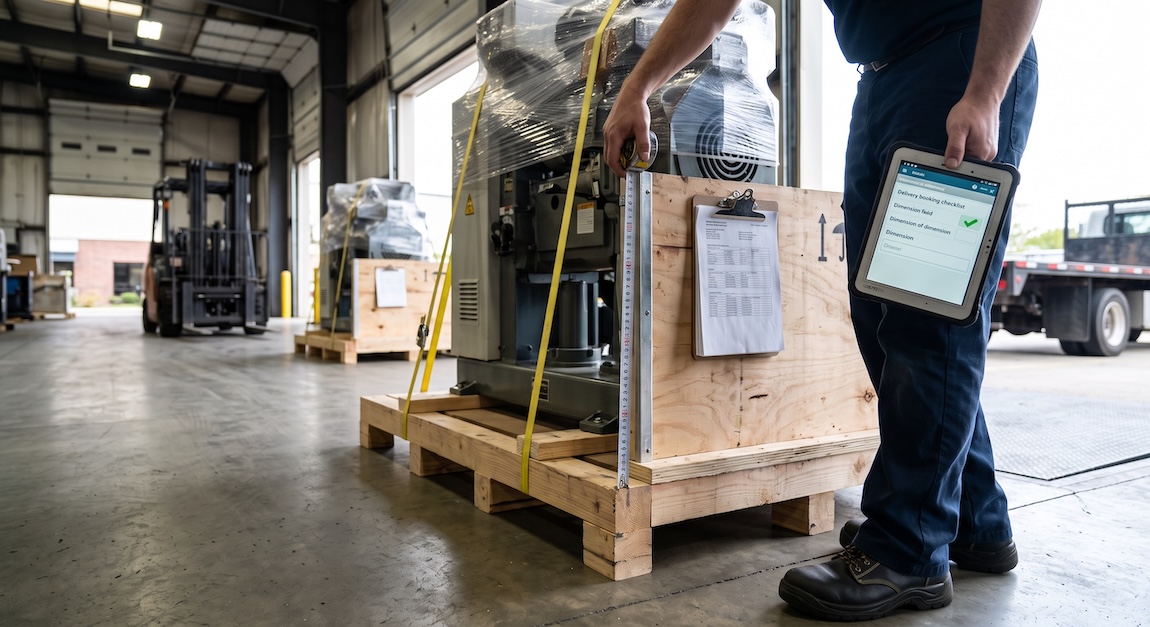
The best time to measure machinery is when the packing work is finished.
Length, width and height should include the skid, crate or transport frame, together with anything that remains outside the main footprint such as handles, guards, pipes or control boxes.
Weight should receive the same treatment.
If the carrier has priced and planned the job around 900 kg, discovering at collection that the packed consignment is actually 1,150 kg is not a minor paperwork correction. It can affect equipment choice, vehicle capacity and the way the load is handled.
A discrepancy does not automatically make the freight unlawful to carry. It does mean the transport plan may need to be reassessed before the load can move.
Can the collection site load the vehicle?
This is one of those questions that seems too obvious to ask until the wrong vehicle is standing outside.
Dispatch teams should know how the equipment will be lifted and what is available on site.
Is there suitable fork access? Is a crane needed? Will the vehicle need to carry specialist loading equipment? Is there enough space for the intended vehicle to manoeuvre?
“The collection can be booked correctly on paper and still fail because nobody checked how the machine was actually going to get onto the vehicle,” says George Wicks-Farr, Head of Operations at Pallet2Ship. “If a three-tonne machine needs a crane and the site only has a small forklift, the driver cannot solve that when they arrive. Loading equipment needs to be part of the transport conversation from the start.”
Then ask the same questions about delivery.
Industrial freight can leave a well-equipped factory and arrive somewhere with completely different handling facilities. That needs to be known while the shipment is being arranged.
Declare the awkward parts
A machine may be technically within the booked dimensions and still have characteristics the carrier needs to know about.
It might be top-heavy, non-stackable or have an offset centre of gravity. There may be batteries, residual fuel, refrigerants or other contents that need checking against carrier acceptance or dangerous-goods requirements.
Those details are far easier to deal with during booking than during loading.
International freight adds another layer. The commercial description, value, commodity code, origin and importer/exporter information should agree across the customs documentation.
A border rejection guide can help dispatch teams identify the document and declaration errors that are worth catching before the freight reaches a customs facility.
Walk around it once before calling it ready
The final check should be physical rather than administrative.
Stand in front of the finished shipment and compare it with the booking.
Has the footprint changed? Is anything protruding? Is the base sound? Can the freight be lifted as planned? Are loose components secured? Has the carrier been told about unusual handling requirements?
Five minutes spent doing that can save a vehicle being sent away empty.
The aim is not complicated. When the driver arrives, the consignment should look exactly like the job the carrier agreed to collect.