Pedestrians, cyclists and motorcyclists are most at risk, highlights Brake as it shares the message that we all have a role to play in keeping each other safe on roads.
- Road Safety Week takes place 15–21 November across the UK.
- In 2025, pedestrians, cyclists and motorcyclists made up 55% of road deaths and serious injuries in the UK.
- New research by road safety charity Brake reveals one in three people know someone who has been in a crash where a pedestrian, cyclist or motorcyclist has died or been seriously injured.
- “Road crashes are not just something that happens to other people. We all have a role to play in keeping each other safe,” says Brake.
- Interview opportunities and road victim case studies available.
One in three people know someone who’s been in a road crash where a pedestrian, cyclist or motorcyclist died or sustained serious injuries. That is according to the findings of a new survey by road safety charity Brake, revealed today (Sunday 15 November) to mark the start of Road Safety Week.
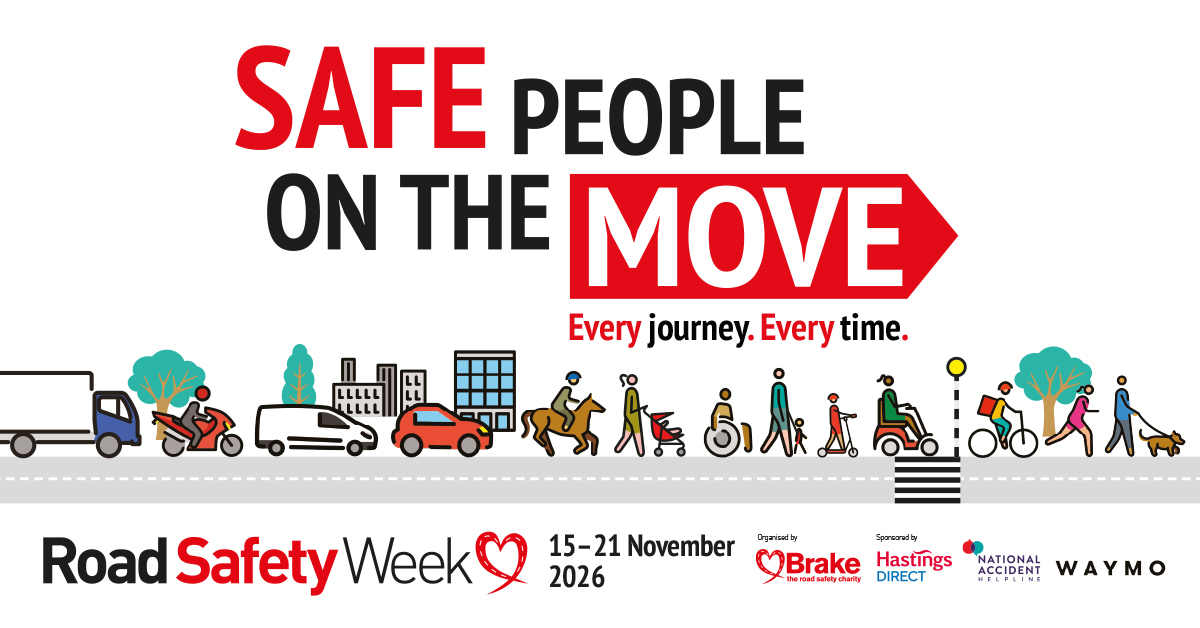
Road Safety Week is an annual campaign run by Brake, beginning on World Day of Remembrance for Road Traffic Victims, to raise awareness of the impact of road death and injury and call for key measures to make roads safer.
Thousands of schools, organisations, communities and individuals have signed up to take part, together reaching more than four million people with important road safety messages.
This year’s Road Safety Week theme is Safe People on the Move, with the message that whoever we are and however we travel, we all share our roads when we are on the move. Whether we walk, wheel, ride or drive, we all play a part in keeping ourselves and others safe, and those with the potential to do the most harm have the greatest responsibility to protect people who are more vulnerable.
‘Safe people’ is a key pillar of the Safe System approach to road safety, which is built upon the concept that all road deaths and serious injuries are preventable, and that all five elements of the road system – safe people, safe roads, safe vehicles, safe speeds, and post-crash care – work together to minimise the chance of a crash, or to prevent death or serious injury if a crash takes place.
People who walk, wheel or ride need greater protection on roads
Brake’s survey polled 3,000 UK adults on several road safety topics, focusing on the most vulnerable road users – those who walk, wheel or ride – and people’s perceptions of how dangerous the roads are for these groups.
The charity found that one-third (32%) of people know someone who’s been involved in a collision in which a pedestrian, cyclist or motorcyclist died or sustained serious injuries. This brings into sharp focus the fact that road crashes are not just events that happen to other people – they affect thousands of people every year. And they are a cause of concern for most people, as 85% of survey respondents said they worry that a loved one could be involved in a crash.
These findings chime with official statistics published earlier this year [1,2], which showed that in 2025, pedestrians, cyclists and motorcyclists made up more than half (55%) of deaths and serious injuries on UK roads (see Table 1).
Of the 31,040 people killed or seriously injured last year in road crashes in the UK, 6,535 were pedestrians (21%), 4,456 were cyclists (14%), and 6,227 were people on motorbikes (20% – 5,950 riders and 277 passengers) (see Table 1).
The total number of deaths and serious injuries on UK roads increased by 4% in 2025 compared with 2024. It is the highest annual number of road casualties since 2018 and marks the 10th consecutive year with no significant improvement in road casualty numbers (see Tables 2, 3 and 4).
Which road users are perceived as least safe?
Cyclists – Brake’s research revealed that cyclists are perceived as being most at risk. More than half (52%) of survey respondents think roads are unsafe for people using a pedal bike or e-bike, and 42% feel unsafe when they cycle. One fifth (20%) said they would like to cycle more but don’t think roads are safe enough. Two-fifths (40%) said cyclists need more protection on our roads.
Pedestrians – Although three-quarters (76%) of respondents said they walk every day or often, nearly a quarter (23%) told us they think roads are unsafe for pedestrians. Nearly two-fifths (38%) think people on foot need more protection on roads, and 43% said we need more safe places for people to walk and cycle.
Motorcyclists – Almost half (45%) of people answering the survey told us they think roads are unsafe for motorbike riders and their passengers, and nearly a third (30%) said motorcyclists need more protection on our roads. Just 6% of all respondents said they ride a motorbike, moped or other powered two-wheel vehicle, but a quarter of those (24%) said they feel unsafe when doing so.
Brake’s survey also found:
- 44% of people think roads are unsafe for people using a wheelchair or mobility scooter.
- 28% say they feel unsafe on roads as a wheelchair or mobility scooter user.
- 30% say they feel unsafe on roads while riding a horse.
The vast majority of people (90%) agree that everyone shares responsibility for using roads safely, but respondents also told us they think that more responsibility lies with drivers. Nearly two-thirds (61%) think drivers need to take extra care to protect more vulnerable road users.
And while 66% agree that everyone who uses roads deserves to be protected from known risks, many respondents hold other people accountable for doing so. Almost two-thirds (62%) said they think they use the roads safely themselves and that other people are the problem. A significant majority (84%) of people told us that road safety is an important public health issue.
For more information on survey findings, go to the Brake website: Brake | Survey results
Ross Moorlock, Brake’s CEO, said:
“Road safety should not be a political battleground or a debate that pits different road users against one another.
“Whoever we are and however we travel – whether we walk, wheel, ride or drive – we all have a role to play in keeping roads safe. But we must also recognise that those with the greatest potential to cause harm carry the greatest responsibility for protecting others.
“As a charity that supports thousands of road victim families every year, we sadly know too well how road crashes devastate the lives of everyone involved.
“Rather than political point-scoring or divisive narratives about a ‘war on motorists’, the focus should be on following the evidence to address an important public health issue and prevent the devastating deaths and serious injuries that continue to happen on our roads every day.”
How people are taking part in Road Safety Week 2026
For this year’s Road Safety Week, thousands of people up and down the country are joining in conversations and finding out how we can all play a part in keeping ourselves and others safe. Brake has provided a free action pack of resources for everyone who signs up to take part.
The action pack is filled with information, ideas and guidance for taking part, and facts and images to share on social media.
There are also activities for schools to get involved by teaching road safety to children and young people, as well as ideas for how organisations that hire people who need to drive as part of their job can manage work-related road risk.
For case studies and information about other events and activities taking place during Road Safety Week 2026, see notes to editors.
Road Safety Week 2026 is organised by Brake and sponsored by Hastings Direct, National Accident Helpline and Waymo.
Toby van der Meer, CEO of Hastings Direct, said:
“Every death or serious injury on our roads has a devastating impact on people, families and communities. At Hastings Direct, we believe we have a responsibility to do more than support people after a collision. We want to help prevent them from happening in the first place. From supporting young drivers to make safer choices, to tackling the dangers of distracted driving, we want to use our data and insights where they can make a real difference. That’s why we’re proud to sponsor Road Safety Week and stand alongside Brake in our shared ambition of zero road deaths. By turning data and insights into action to encourage safer driving, we can help make our roads safer for everyone.”
James Saralis, CEO of National Accident Helpline, said:
“National Accident Helpline are proud to be supporting Brake’s Road Safety Week 2026 and the vital work the charity does to raise awareness, support affected families and campaign for safer roads. Everyone deserves to feel safe on our roads, and we hope this week encourages more people to think about the part we can all play in making that a reality.
“We understand the devastating impact a crash on the road can have, not just on those directly involved, but on their families and loved ones too. We see how lives can be changed in an instant, and why preventing these tragedies is so important.”
Heather Aijian, head of public affairs at Waymo, said:
“Safety is at the heart of everything Waymo does and we’re proud to partner with Brake this Road Safety Week. When it comes to the safety of our roadways, Waymo is working with leading organisations like Brake to change the status quo and advance our shared mission of creating safer journeys for everyone.”